Key Takeaways:
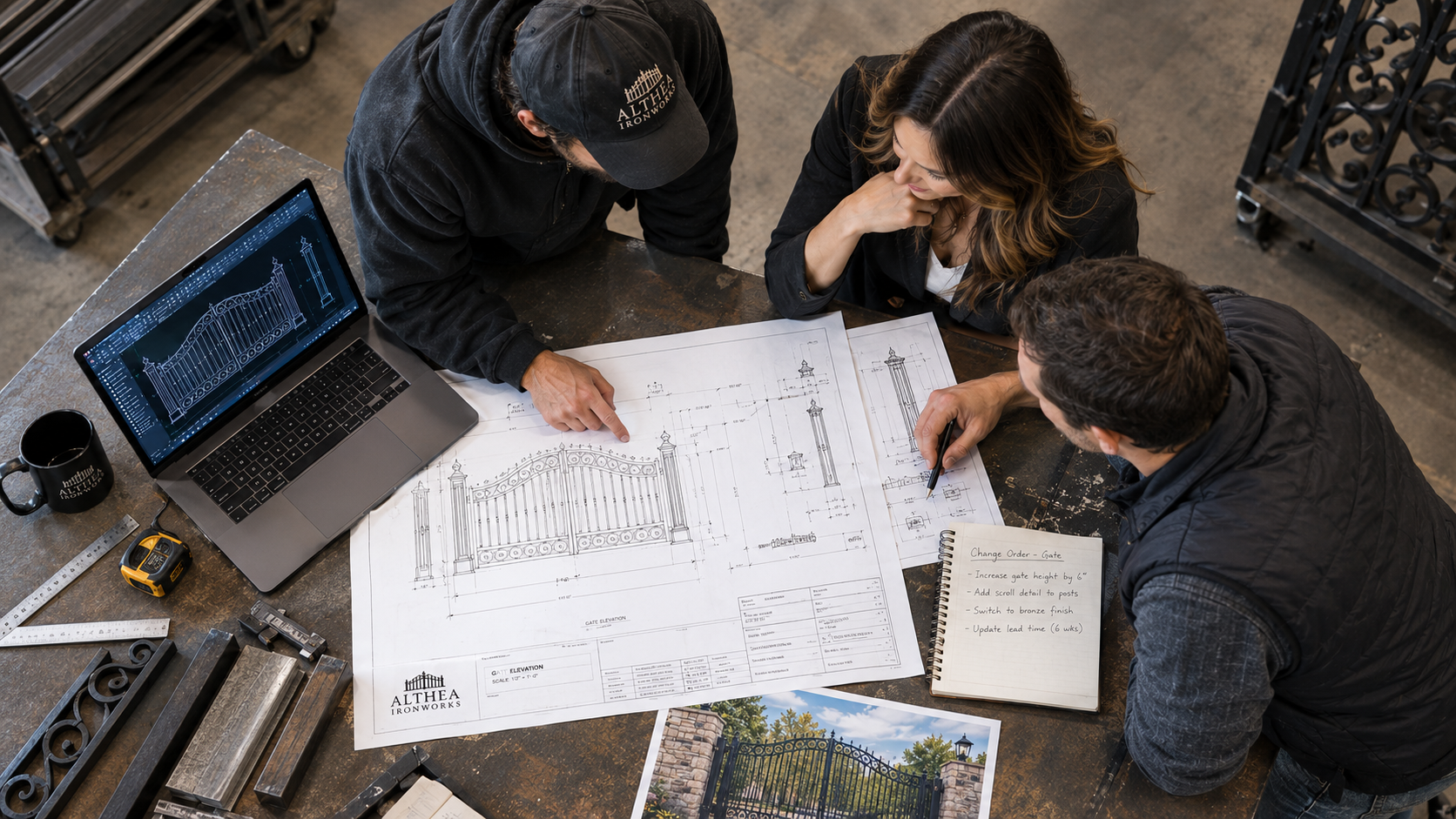
Most shops lose money on changes not because they build the job wrong, but because the change never got documented. This guide covers when a change becomes expensive, what a change order must contain, what to say in the moment, the four arguments customers make, and how a dimensioned drawing gives you a baseline that settles the argument before it starts.
A change order gets paid when it's signed before the work starts and itemized enough that the customer can see where the number comes from. Everything else — the wording, the form, the filing system — is secondary to those two things. A verbal agreement and a lump-sum total is how shops end up doing free work while staying perfectly polite about it.
Most fabrication shops don't lose money by building things wrong. They lose it when the customer changes their mind after the steel is cut, nobody writes it down, and the shop absorbs the difference to keep the peace.
Why timing decides everything
The same change costs wildly different amounts depending on when it arrives.
At the drawing stage, a change is a redraw. Cheapest point by far.
Once material is ordered, you're into restocking fees, freight, and special-order items that may not be returnable at all.
After the parts are cut, the material is gone. That's scrap.
After welding and assembly, you're cutting apart, re-fitting, re-welding, and grinding.
After finishing, you're stripping and re-coating, or more often remaking the part.
Once it's installed, you're removing, transporting, reworking, and re-installing.
The cost curve isn't linear — it steps up sharply at each point where the work becomes harder to undo. And the reason finished work is so expensive to alter isn't the metal. It's the handling: additional setup, custom fixturing, secondary operations, extra material movement on a part that was already done. None of that was in your original price because none of it was in the original job.
Say this out loud at the drawing stage: "Changes are easy and cheap right now, while it's still a drawing. Once we cut steel they get expensive, and after powder coat we're usually remaking the part. So this is the moment to tell me anything you're unsure about."
Said early, that's helpful advice. Said after the invoice, it sounds like an excuse. Same information, completely different reception.
The one rule
Get it in writing before the work starts. Every time.
Verbal approval is close to worthless when the invoice is disputed. And there's a psychological reason the timing matters so much: when a customer is watching work in progress, they're in a decision-making frame of mind, weighing value. Once the job is finished, they're in payment mode, looking only at cost.
A signature requested before you start is easy to get. The same signature requested afterward is hard. Same change, same price, completely different answer.
What a change order must contain
- Job name, address, and the original contract or quote it amends
- A change number and the date
- What was originally agreed, quoted in one line from the contract
- What is changing, described so a stranger could understand it
- Who requested it, and when
- Itemized cost: labor hours times rate, materials, finishing, any scrapped work
- New contract total
- Effect on the schedule, in days, stated explicitly
- Both signatures and the date, before work begins
Itemize, always. "Change to gate: $1,240" invites an argument. Six hours of labor at your rate, plus the scrapped frame, plus a second run through the booth, does not — because the customer can see where the number comes from. The total is identical. The conversation is not.
What to say when the change arrives
Most changes arrive verbally, on site, mid-job, from someone being friendly. The skill is turning that into paper without turning it into a confrontation. Say yes to the work and yes to the paperwork in the same breath.
"While you're here, could you also…"
→ "Absolutely, I can do that. Let me write it up as a change order so we're both clear on the cost and the timing before I start."
"It's only a small thing, can't you just throw it in?"
→ "Happy to look at it. Let me price it properly and get you a number today — some small things really are small, and some of them mean re-cutting a frame. I'd rather tell you which before we commit."
The drawing is ambiguous and the PM tells you what he wants.
→ "Great — I'll email you to confirm that so we've both got it on record, then I'll build to it."
That last one prevents the trap that catches ornamental shops most often. The prints are vague, you ask the project manager, he answers clearly and in good faith, you build exactly what he said. Later the GC refuses the change order and argues you should have followed the prints — and because the clarification was verbal, you have nothing to point at. One email sent before you cut turns a week of free labor into a paid change.
The four arguments, answered in advance
"I never approved that." A signature obtained before work started. If the change genuinely came up mid-weld and a signature wasn't possible, send a confirming email the same day and keep the reply.
"That should have been included in the price." A detailed original scope. The more specific your quote, the more obvious it is when something falls outside it. Vague quotes make every change arguable — write what is included and what is not.
"That's too much for what you did." Itemization. A total invites a haggle; a breakdown invites a question you can answer.
"You should have told me before you started." Present every change order before doing the work. No exceptions. This is the one that protects the relationship, not just the invoice.
Commercial work runs by different rules
Residential change orders are a conversation with the person paying. Commercial change orders run through a contract, and the contract usually specifies who is allowed to authorize one.
Many construction contracts name a single designated representative as the only person who can approve a change, and state that the contractor isn't compensated for extra work requested by anyone else. The superintendent who asks you for something on site may not be that person. Before the job starts, ask in writing: who can sign change orders, and what's the process?
On commercial jobs, an ambiguity in the drawings isn't a change order — it's a Request for Information. Submit the RFI, get the written answer, then raise a change order if the answer costs more than your bid assumed. The RFI converts "you should have followed the prints" into "here is what you told me the prints meant."
Also watch the notice deadline. Commercial contracts often require written notice of a claim within a set number of days. Miss that window and a legitimate claim can be waived no matter how right you are. Find the clause before you sign, and put it on the calendar.
This is an industry-wide problem, not a you problem
If it feels like documentation disputes are constant, the data agrees. The Arcadis Global Construction Disputes Report has tracked dispute causes for over a decade, and errors and omissions in contract documents ranked as the top cause in North America in six of nine consecutive years.
Industry estimates commonly put change orders at roughly 5 to 15 percent of total contract value, and the largest controllable driver is missing or conflicting information in the drawings and specifications.
That's commercial data — projects with contracts, schedules and lawyers. Your gate job has none of those, which means the drawing is the only protection you have.
How a drawing does the work for you
Everything above assumes you have a clear record of what was originally agreed. That record is what a change order amends, and it's the difference between a conversation about scope and a conversation about memory.
A dimensioned drawing is the strongest version of that record, for four reasons.
It defines the baseline precisely. A change order has to state what was originally agreed. "Ornamental driveway gate, 12 feet, wrought iron" describes a hundred different gates. A drawing describes one — picket spacing, frame size, top rail profile, post positions, finish. When the customer asks for something different, the difference is visible rather than arguable.
A signed drawing is stronger than a signed scope. Both are agreements, but only one shows the customer what they're buying. Most disputes in this trade come from the gap between what the customer pictured and what you quoted. Prose doesn't close that gap; a picture does. A signature on a drawing means they saw it.
It tells you what the change actually costs. Redraw the gate with the change and the bill of materials regenerates. Now you have the real material delta, the new cut list, and the parts that just became scrap. That's what makes an itemized change order possible — you're not estimating the difference, you're reading it.
It proves the change is material. This is the one that ends the "it's only a small thing" conversation. Put the original drawing and the revised one side by side and the customer can see that the picket count changed, the frame grew, the footing moved. You're not asserting that the change is significant. You're showing it. Then they sign the revised drawing as part of the change order, and the new baseline is recorded exactly like the first one was.
That last step matters more than it sounds. A change order that updates the price but not the drawing leaves you with a signed document and an out-of-date picture, and the next change gets argued against the wrong baseline.
Get the printable version
We've put this whole guide, including a ready-to-use change order form, into a free six-page PDF you can print and keep in the shop. It covers the cost curve, the scripts, the awkward situations, contract language worth having in your standard terms, and the form itself.
Download Getting Paid for Changes →
Drawings in minutes, not hours
The honest objection to all of this is time. If a dimensioned drawing takes ninety minutes to produce, you'll do it on the big jobs and skip it on the rest — and the jobs you skip are exactly where the arguments happen.
FabCAD exists to remove that constraint. Enter your dimensions, select your materials and style, and it draws the gate, railing or fence and generates the bill of materials at the same time. When the customer wants it eight inches wider, you change one number and the drawing and the parts list both update together.
That's what makes everything in this guide practical rather than theoretical: a drawing cheap enough to produce on every quote, fast enough to revise while the customer is still standing there, and detailed enough to settle the argument before it starts.
This article is a practice aid, not legal advice. Contract terms, notice periods, lien rights, and home improvement contract rules vary by state and country. Have your own attorney review your contract and change order language before use.