Key Takeaways:
A professional drawing attached to a quote shifts the customer from comparing prices to comparing value. It's the most practical way for a small shop to win more jobs, bigger jobs, and more profitable ones.
- Treat every proposal as an audition for design, craftsmanship, and professionalism
- Send an elevation, a scope list, a line-item price, and terms with every quote
- Show two or three design options to turn yes-or-no into which one
- Tie a payment to drawing approval, and use the signed drawing to price change orders
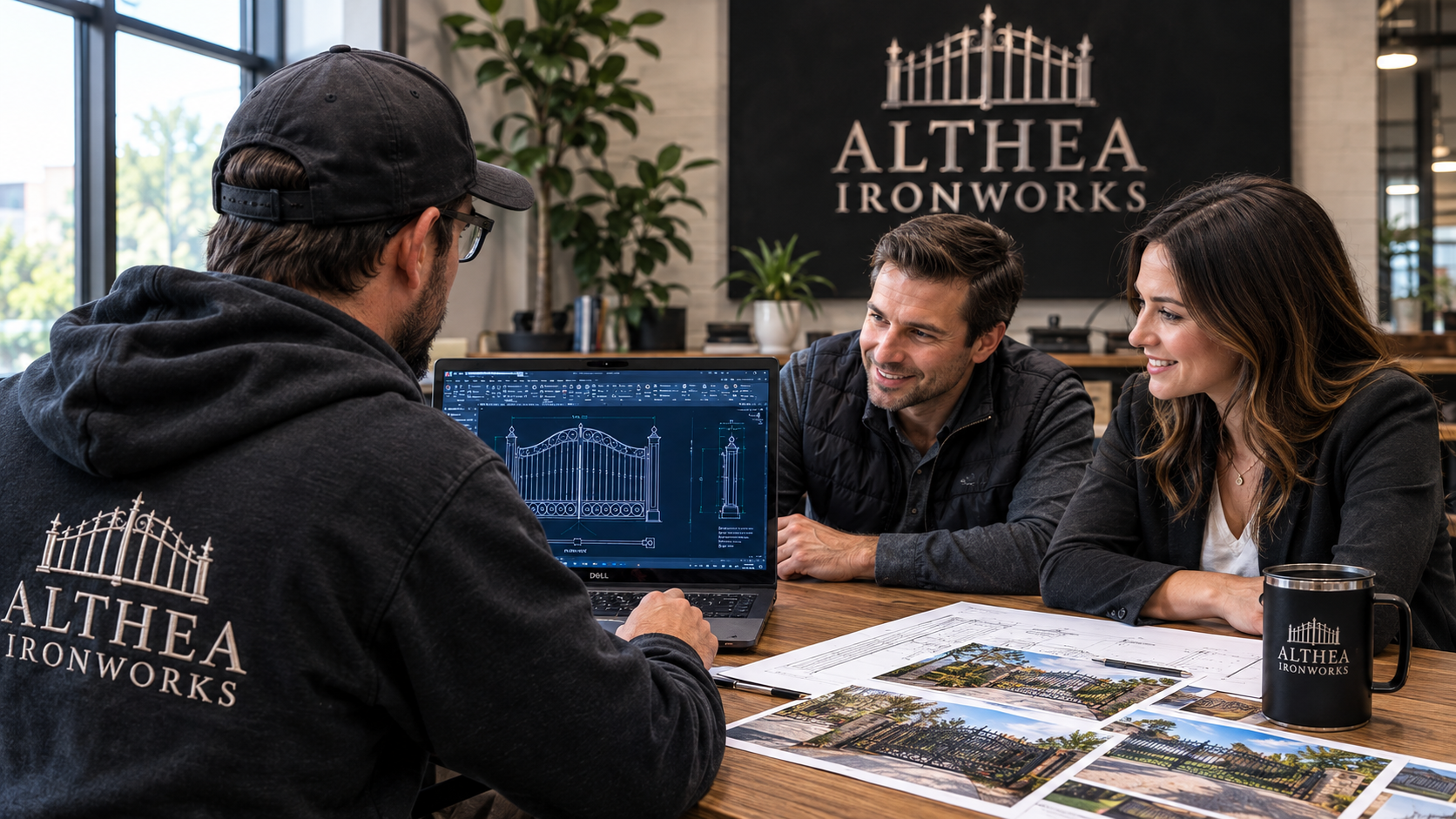
A dimensioned drawing attached to a quote changes what the customer is buying. Instead of comparing your number against two other numbers, they're comparing a specific gate they can see against two vague promises. That shift from price comparison to value comparison is the single most valuable thing a small fabrication shop can do to win more jobs, bigger jobs, and more profitable ones.
Professional shop drawings elevate the conversation from a price comparison to a value equation.
Take competitors out of the conversation early
When you're proposing on a job, it's not just an estimate. It's an audition. This is your opportunity to show the customer what to expect in design, craftsmanship, and professionalism. Whether it's a homeowner, a GC, or a corporate buyer, customers want to know not just how good your work is, but how good you are to work with.
Professional drawings don't just help you win the job. They direct the customer to focus on what matters most.
Premium design. A driveway or garden gate does much more than create privacy or security, and a professional drawing shows how impactful design can be. Leading with a design showcases your talent and builds rapport early.
Craftsmanship. Professional drawings show that you take pride in your work, operate at a higher level, and charge accordingly. Help customers see what sets your work apart and appreciate the finer details.
Professionalism. A design and a detailed estimate tell customers what to expect from the experience and give you both a basis for any changes down the line. Presenting a detailed proposal promptly signals this isn't your first rodeo and gives the customer peace of mind.
Why fabrication gets commoditized
Winning on price is a dangerous game. It can be a race to the bottom, and it attracts the wrong kind of customers: the ones who don't truly value your work.
A customer getting three bids for a driveway gate usually can't tell your work from anyone else's. They're not fabricators, and they probably haven't bought many gates, if any, before. They can't evaluate weld quality, they don't know what 11ga versus 14ga means for a 16-foot leaf, and they have no way to judge whether your post detail will still be plumb in five years.
When a buyer can't distinguish quality, they default to the one dimension they can evaluate: price. That's not because they're cheap. It's because you haven't given them anything else to compare.
The shop that wins on price in that scenario often wishes it hadn't. The shop that loses learns the wrong lesson and bids lower next time.
The way out isn't a better sales pitch. It's giving the customer something concrete to evaluate.
What a drawing actually does in the sale
It makes you the only specific bid. Two competitors say "custom wrought iron driveway gate, $8,400." You say the same thing with an elevation showing the arch, the picket spacing, the cast rosettes, and the actual dimensions of their opening. Yours is now the only quote the customer can picture. The other two became abstractions.
It removes uncertainty, and uncertainty is expensive. A customer spending five figures on something that doesn't exist yet is carrying real anxiety about whether it'll look right. Every bit of that anxiety is priced into how much they're willing to pay and how long they take to decide. A drawing converts "I hope this turns out how I'm imagining" into "this is what I'm getting." People pay more for certainty, and they decide faster.
It signals competence before you've welded anything. Fair or not, the customer judges your fabrication by the quality of your paperwork, because your paperwork is all they can see at decision time. A dimensioned drawing says this shop is organized. A number scrawled on a business card says something else.
It anchors the conversation on the design rather than the price. When a customer is looking at a drawing, the questions change. "Can we make the top arch higher?" is a design conversation. "Can you do it for $X?" is a price conversation. Whichever document you put in front of them determines which conversation you have.
It defines scope in writing. Everything shown is included. Everything not shown isn't. That sentence saves arguments later, and the ability to point at a drawing is worth more than the ability to recall a phone call.
What to actually send with a quote
You don't need a presentation package. You need four things:
- An elevation of their gate at their dimensions, with the design they discussed, ideally shown in front of the job site
- A short scope list of what's included and, explicitly, what isn't (posts? concrete? automation? electrical? removal of the old gate?)
- The price, broken into a few meaningful lines rather than one number
- Terms: deposit, approval milestone, balance, and lead time
That's one or two pages. The drawing does most of the work.
Using drawings to upsell and close the deal
This is where most shops leave money on the table.
When you show a customer one design at one price, you've framed the decision as yes or no. When you show the same gate in two or three versions (plain pickets, pickets with cast rosettes, the full treatment with scrollwork and a finial-topped arch), you've reframed it as which one.
Some customers take the base option. Some take the middle. A meaningful number take the top one, and those are customers who would have said yes to the base gate and never known the other existed.
The reason shops don't do this is time. Drawing three versions by hand is three times the work on a job you haven't sold yet. That math is exactly why it doesn't happen, and it's exactly what parametric software changes. When the infill and the decorative elements are components you swap rather than geometry you redraw, a second and third option cost minutes instead of hours.
The same logic applies to upgrades you'd otherwise never mention: heavier frame stock, a better finish, automation readiness. Shown visually, these become choices. Described verbally, they become confusing.
Drawings and actually getting paid
Winning the job is half of it. Here's where drawings protect the money after the handshake.
Approval as a payment milestone. Structure it so the customer signs off on the shop drawing before fabrication starts, and tie a payment to that signature. You get working capital, and you get documented agreement on exactly what you're building.
Change orders become straightforward. When the customer asks for something different after approval, you're not arguing about whether it was part of the original deal. You have a signed drawing showing it wasn't. Repricing a change is a two-minute conversation instead of an uncomfortable one. Shops without drawings absorb these changes constantly, and it's a quiet, steady drain on margin.
Final payment disputes largely disappear. "This isn't what I expected" is hard to sustain against a drawing the customer approved. Most disputes in this trade come from a mismatch between what the customer imagined and what got built, and a drawing closes that gap before any steel is cut.
Your estimates get more accurate. A drawing with a real bill of materials means you're pricing from a parts list rather than a feeling. Over a year, the difference between estimated and actual material usage is real money, and you can only manage it if you're measuring it.
The objections worth addressing
"It takes too long, and most quotes don't turn into jobs." This is the honest objection, and it's why quoting by feel persists. If a drawing takes ninety minutes, you can't do it for every quote. If it takes fifteen, you can. Whether drawings are practical for your shop is mostly a question of how long they take to produce, which is a tooling question, not a discipline question.
"My customers don't care about drawings." Some don't. The ones who don't are frequently the ones shopping purely on price, and those are the jobs with the thinnest margins and the most friction. The customers who do care are the ones you want more of.
"A competitor will take my drawing and shop it." It happens. It happens less than shops fear, and the customer who does it was going to buy on price regardless. Protect your work by adding a custom watermark for your shop and a copyright notice to every drawing. FabCAD provides simple tools and samples for both.